before measurable time
The Original Nothing
The opening vision places the [Narrator (God)](entity:character-recall-character-god-9913eabab587) in a universe that contains nothing and wants nothing. Without language, thought, sight, or awareness of time, this existence is complete precisely because it has no desires.
from birth until age two
The Infant Tube
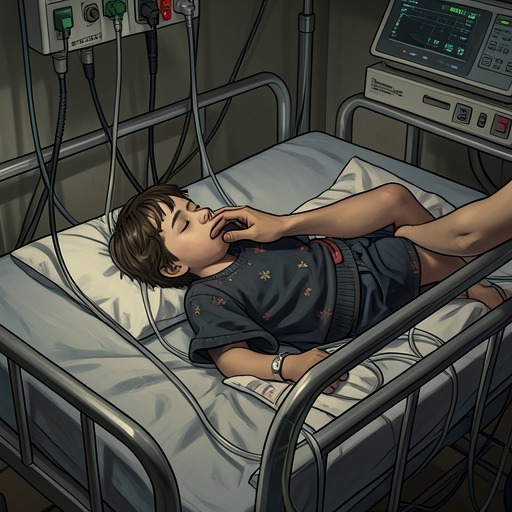
Born into a Belgian family living in [Japan](entity:location-recall-location-820f849a273a), the child remains motionless and silent. The parents and specialists call the baby a vegetable, but the narration names this state the Tube: a living body that takes in nourishment and gives nothing back.
during the first two years
The Parents’ Tests
Doctors test the child’s reflexes and find none; light does not move the pupils, and the baby never cries. The parents resist advice to hospitalize the child, relieved that this apparently lifeless infant is at least still alive.
during infancy
The Starvation Experiment
Trying to provoke a response, the parents withhold food and drink for three days. The child accepts the deprivation without protest, and the frightened parents give the baby sugar water rather than tell the doctors what they tried.
by age two
A Life Without Motion
The child grows physically but never crawls, walks, speaks, or reacts to music. The parents eventually stop trying to make the baby human, while the narration presents inertia as the force that keeps the child absorbed in an unmoving existence.
during the first two years
The Theory of Refusal
The narration argues that sight requires choosing one thing over another, and that life begins in this capacity to reject. The Tube has made no choice at all, so its apparent calm is not peace but an absence of life as people ordinarily understand it.
during infancy
The Contingency of Mind
Reflecting on evolution, the narration imagines a disturbing thought arriving in a brain like grit in an oyster: an accident that forces a creature out of passivity. The Tube seems to have escaped that mental accident, while the rest of humanity may owe its motion and speech to such disruptions.
at age two
The First Great Rage
One day the child sits up in the crib and howls with startling fury. The family gathers around in amazement as the once-placid baby kicks, glares, and finally collapses asleep; the family celebrates the outburst as a sudden return to life.
after the first awakening
A Voice Without Words
The child’s new anger comes with an urge to control the world by naming it, but speech produces only noise. The narration imagines the frustration behind the screams: other people can speak and command things, while the child’s mouth cannot yet express the authority it feels.
when the child is two and a half
The Grandmother Arrives
After a long journey from [Belgium](entity:location-recall-location-3c9126bcb552), the paternal [Grandmother](entity:character-recall-character-8fdee949c107) reaches the family home near [Shukugawa](entity:location-recall-location-19768a6dc80c). The parents warn her about the child’s relentless screaming, but she goes directly to the crib carrying a gift from Belgium.
February 1970
White Chocolate Awakening
The [Grandmother](entity:character-recall-character-8fdee949c107) offers the child a stick of [White Chocolate](entity:object-recall-object-5a1e0a35fca6). Its sweetness overwhelms the baby with pleasure, and an inner voice announces the discovery of a self: the child is no longer merely an “it” but a “me.”
February 1970
The Child Enters the Family
The [Grandmother](entity:character-recall-character-8fdee949c107) carries a newly docile child downstairs and introduces her new friend to the astonished parents. She keeps the chocolate’s role secret, while the Narrator remembers the sweetness as the event that made life—and memory—begin.
after February 1970
Learning to Walk
Once pleasure has given the child a reason to engage with the world, she learns to stand, walk, and run. Walking expands her view, while running offers a first taste of mischief and escape.
after the child begins walking
The First Spoken Words
The Narrator chooses “Mama” and “Papa” as her first words because they reassure her parents without revealing how much she already thinks. She considers the weight of speaking aloud, treating every spoken name as an act that recognizes and helps establish its object.
soon after the first words
The Vacuum’s Revelation
Watching her [Mother](entity:character-recall-character-84cf5babf108) use a vacuum cleaner, the Narrator sees it swallow small objects and make them disappear. She recognizes it as a kind of divine annihilator and names it aloud, surprising the family with a third word.
during the weeks after her first words
Naming the Household
The Narrator names [Juliette](entity:character-recall-character-juliette-99dd48fdc5e1) and [Nishio-san](entity:character-recall-character-nishio-san-a78443c71e98), while refusing to name her older brother and the visiting [Hugo](entity:character-recall-character-hugo-4be10b564541). She sees names as powerful gifts that delight their recipients, though she also notices that ordinary speech can deceive, quarrel, or wound.
after the first six spoken words
The Word Death
When the [Mother](entity:character-recall-character-84cf5babf108) tells her that the [Grandmother](entity:character-recall-character-8fdee949c107) has died, the Narrator answers with the word “death” and leaves the room. She insists inwardly that she knows the subject intimately because she once endured a state close to nonexistence.
after the Grandmother’s death
The Ceiling as Tomb
The Narrator recalls the ceiling she stared at during her years as the Tube, interpreting it as a lid that kept thought and sight from rising. She understands death as an enclosing darkness, yet recognizes that its stillness can also seem seductive.
after the Grandmother’s death
Remembering the Grandmother
The Narrator sits on the stairs thinking of the [Grandmother](entity:character-recall-character-8fdee949c107) and her chocolate, imagining an exchange in which the Grandmother gave her life and then died. Memory becomes the Narrator’s way of keeping her benefactor present.
soon after the Grandmother’s death
A Secret Japanese Conversation
Unable to ask her questions in French without exposing her abilities, the Narrator speaks privately with [Nishio-san](entity:character-recall-character-nishio-san-a78443c71e98) in Japanese. She asks why people die and hears that old age may make death like sleep, while the reasons for young deaths remain unclear.
during the conversation about death
Nishio-san’s War Story
[Nishio-san](entity:character-recall-character-nishio-san-a78443c71e98) recounts the 1945 bombing of [Kobe](entity:location-recall-location-36b6d53677ce), when she was buried alive beneath the ruins and repeatedly dug toward the sound of life. She emerged to discover her family dead, and the account gives the Narrator a vivid story of survival that ends in terrible loss.
when the Narrator is about two and a half
Kashima-san Joins the Household
As the Narrator’s demands grow, the parents hire [Kashima-san](entity:character-recall-character-kashima-san-be90619d6873) to assist [Nishio-san](entity:character-recall-character-nishio-san-a78443c71e98). A former aristocrat embittered by [Japan](entity:location-recall-location-820f849a273a)’s defeat and the loss of her status, Kashima-san despises the foreign family and treats Nishio-san with contempt.
after Kashima-san’s arrival
The Sacred Child
[Nishio-san](entity:character-recall-character-nishio-san-a78443c71e98) treats the Narrator as an okosama, a sacred child whose wishes deserve obedience and whose place in the household is almost divine. The Narrator responds by choosing the Japanese language and imagining herself as a ruler surrounded by devoted followers.
spring when the Narrator is two and a half
The Garden Kingdom
In the family garden, the Narrator experiences plants and flowers as subjects in a private paradise. She tells a bud to blossom and finds a peony the next day, taking the coincidence as evidence of her power and deepening her self-deification.
spring when the Narrator is two and a half
Kashima-san Refuses the Child
[Kashima-san](entity:character-recall-character-kashima-san-be90619d6873) refuses to share her food and slaps the Narrator when she reaches for it. The Narrator attempts to punish and charm her in turn, but neither a withheld garden nor a carefully staged display of beauty can win her admiration.
after Kashima-san’s refusal
Testing Kashima-san’s Restraint
The Narrator tests [Kashima-san](entity:character-recall-character-kashima-san-be90619d6873) with flowers, favorite food, a rainbow, and an elaborate kimono. Kashima-san remains unmoved, and the child concludes that the older woman suffers from a disease of self-denial before recognizing that her own power has limits.
during the Narrator’s early childhood in Japan
Hugo Enters the Family
A Vietnamese businessman’s son, [Hugo](entity:character-recall-character-hugo-4be10b564541), is left in the care of the Narrator’s parents during political turmoil. The Narrator resents his closeness with her brother and refuses to name him, but Hugo will later become crucial to her survival.
April 1970
The Sea at Tottori
The family travels to [Tottori](entity:location-recall-location-798e7b797d72), where the Narrator encounters the [Sea of Japan](entity:location-recall-location-fa9eb64372c8) and first enters the water. Its waves lift her beyond the pull of the earth, and she cries out with delight at the new sensation.
April 1970
Drowning at Tottori
Walking toward Korea, the Narrator reaches a sudden drop in the seabed and begins to drown while the beachgoers watch. She calls for help in Japanese and then French, and beneath the surface becomes transfixed by the sunlight and moving sparks.
April 1970
Hugo Raises the Alarm
[Hugo](entity:character-recall-character-hugo-4be10b564541) notices the Narrator disappearing underwater and alerts the [Mother](entity:character-recall-character-84cf5babf108), who pulls her from the sea. Afterward, the Narrator thanks him aloud in French, unexpectedly revealing to the family that she can speak.
after the Tottori rescue
Life Worth the Effort
Lying on the beach, the Narrator considers how [Hugo](entity:character-recall-character-hugo-4be10b564541)’s intervention made her continued existence possible. Looking at her family, the sky, and the sea, she decides that the world is beautiful and that living is worth the effort.
after the Tottori trip
The Lake Becomes a School
[Nishio-san](entity:character-recall-character-nishio-san-a78443c71e98) takes the Narrator to [Little Green Lake](entity:location-recall-location-f525d4a0f8e6) each morning, where she learns to swim underwater with her eyes open. The landscape becomes a surrounding circle of beauty, and water turns into a place in which she feels at home.
spring 1970
Reading Jesus’s Story
After seeing an image of Jesus on the cross, the Narrator identifies with his exposure to a crowd that watches rather than intervenes. She decides that books contain the truth and secretly teaches herself to read from her brother’s Tintin comics.
late April 1970
The Night Window
Moved to an attic room, the Narrator delights in its unfamiliar ceiling and objects, then becomes fascinated by the night air and violet sky through an open window. She climbs onto the sill, falls outward, and hangs over the void until the [Mother](entity:character-recall-character-84cf5babf108) discovers and pulls her back inside.
after the attic fall
Sharing Juliette’s Room
The attic becomes the brother’s room, and the Narrator moves into [Juliette](entity:character-recall-character-juliette-99dd48fdc5e1)’s room. She spends nights watching her sister sleep, learning the rhythm of her breathing and finding comfort in another person’s rest.
May 1970
The May Carp Streamer
The Narrator sees a carp streamer raised for boys and learns that girls have no corresponding month. The custom makes her question why masculinity receives a public celebration and sharpens her awareness of gender and unequal recognition.
May 1970
The Carp at Futatabi
[Nishio-san](entity:character-recall-character-nishio-san-a78443c71e98) takes the Narrator to Futatabi Arboretum to see real carp. She finds the fish grotesque and overfed, contrasting them with the dignity of the ancient trees; their association with boys only confirms her contempt for them.
June 1970
The Blue-Eyed Noh Singer
At an outdoor Noh performance, the Narrator watches her [Father](entity:character-recall-character-dfcac2918982) sing in elaborate costume and is frightened by the unfamiliar sounds. The performance reveals little to her about his work as consul, but his unusual artistic life has become a deep bond between him and [Japan](entity:location-recall-location-820f849a273a).
beginning in 1967
The Father’s Noh Apprenticeship
Before the Narrator’s birth, the [Father](entity:character-recall-character-dfcac2918982) arrived in [Osaka](entity:location-recall-location-e97c45ac2ea1) as a diplomat and fell in love with Japanese culture. After a Living Treasure mistook polite praise for profound understanding, he accepted lessons in Noh and became known as the Singer of Noh with Blue Eyes.
during the Narrator’s early childhood
The Bible in Secret
While the family assumes she is looking at pictures, the Narrator secretly reads the New Testament. The story of Mary Magdalene washing Jesus’s feet captivates her, though she does not understand the nature of the woman’s sins.
July 1970
Rainy Season Rapture
As [Japan](entity:location-recall-location-820f849a273a)’s rainy season begins, the Narrator spends long hours watching storms and imagining the clouds attacking the inert earth. She often abandons shelter to lie in the rain, experiencing immersion as a form of joy and identifying herself with the water.
July 1970
The Father Falls into a Drain
During a walk through flooded streets, the [Father](entity:character-recall-character-dfcac2918982) disappears into an open storm drain and calls to the Narrator from below. She mistakes the accident for his secret profession, wanders home, and forgets to tell the [Mother](entity:character-recall-character-84cf5babf108) where he is until she returns and alerts the family.
July 1970
The Father Is Rescued
The [Mother](entity:character-recall-character-84cf5babf108) and neighbors pull the [Father](entity:character-recall-character-dfcac2918982) from the drain with a rope. The Narrator realizes his fall was an accident rather than his occupation, and her mistaken theory about his work collapses along with her hopes for a family connection to water.
July 1970
Becoming Rain
The Narrator continues swimming through the storms, taking the water into her mouth and imagining herself as rain: generous, persistent, and impossible to contain. [Nishio-san](entity:character-recall-character-nishio-san-a78443c71e98) warns that she will dissolve, but the Narrator feels she has already merged with her element.
summer 1970
Stories and Disbelief
The Narrator invents stories about a brave talking donkey, then discovers that [Juliette](entity:character-recall-character-juliette-99dd48fdc5e1) disbelieves both her inventions and her true claims about reading and her age. She accepts that she is not readily believed and begins telling stories for their own sake.
summer 1970
The Kitchen Argument
Hidden beneath the kitchen table, the Narrator overhears [Kashima-san](entity:character-recall-character-kashima-san-be90619d6873) accuse [Nishio-san](entity:character-recall-character-nishio-san-a78443c71e98) of serving the foreign family and being blind to their contempt. Nishio-san defends the family and says that she loves the child, while Kashima-san warns that affection cannot make her part of the household.
summer 1970
Nishio-san Announces Her Departure
The next day [Nishio-san](entity:character-recall-character-nishio-san-a78443c71e98) tells the [Father](entity:character-recall-character-dfcac2918982) that she plans to leave, citing exhaustion and her need to care for her twin daughters. The Narrator clings to her and learns from the [Mother](entity:character-recall-character-84cf5babf108) that the family will eventually leave [Japan](entity:location-recall-location-820f849a273a) as well.
summer 1970
The Family Will Leave Japan
The [Mother](entity:character-recall-character-84cf5babf108) explains that the [Father](entity:character-recall-character-dfcac2918982)’s diplomatic work will take the family elsewhere and that their destination and departure date are unknown. The Narrator protests that [Japan](entity:location-recall-location-820f849a273a) is her country and fears that leaving it will destroy her.
after the resignation crisis
Nishio-san Decides to Stay
The [Father](entity:character-recall-character-dfcac2918982) speaks privately with [Nishio-san](entity:character-recall-character-nishio-san-a78443c71e98), who returns to the Narrator and promises to stay. The child is comforted but understands that the promise only postpones the eventual separation, making the present attachment more precious and more painful.
after Nishio-san agrees to stay
The Vow to Remember
The Narrator becomes solemn and jumps at the playground repeating, “[You must remember!](entity:expression-recall-expression-you-must-remember-f86d9d364809)” She understands memory as a way to preserve the garden, the people, and the beauty that must someday be taken from her.
August 1970
The Third Birthday
On her third birthday, the Narrator expects a village celebration and a stuffed elephant. Her parents instead lead her to the garden pool, where they present three live carp, convinced that the fish reflect her interests.
August 1970
Naming the Three Carp
Disappointed by the gift, the Narrator nevertheless pretends to approve and names the fish Jesus, Mary, and Joseph. Her parents find the names amusing, while the Narrator begins a daily ritual of feeding the fish rice cakes.
each day after the birthday
The Feeding Ritual
At noon the Narrator feeds the carp, recasting the meal as a religious ceremony. The fish’s enormous mouths and frantic competition repel her, and she becomes increasingly unable to eat after watching them.
during the weeks of feeding the carp
The Meaning of Disgust
The Narrator begins to wonder why the fish’s mouths horrify her when other disturbing sights have not. She concludes that disgust reveals something essential about a person, and the carp’s exposed digestive bodies seem to reflect the vulnerable machinery of human life.
mid-August 1970
The Garden Begins to Decline
As the garden becomes overripe, the Narrator senses that growth is giving way to decay. She does not yet understand the seasons’ return, but feels that nature is concealing an approaching loss and retreats to the spinning top for reassurance.
late August 1970
The Voice of the Tube
During another feeding, the Narrator becomes absorbed in the carp’s gaping mouths and hears an inner accusation: she too is a tube, born from a tube, dependent on ingestion and emptiness. The voice insists that life is a consuming process without lasting fulfillment.
late August 1970
The Fall into the Koi Pond
Overwhelmed by the choice between the repellent demands of life and the decay she sees in the garden, the Narrator collapses into the pool and strikes her head. Underwater, she feels calm and deliberately looks at the bamboo instead of trying to reach the surface.
late August 1970
Kashima-san Watches
[Kashima-san](entity:character-recall-character-kashima-san-be90619d6873) appears above the water and meets the Narrator’s gaze without rescuing her. The child interprets this stillness as acceptance of her choice and as proof that the woman who hated her can at last understand her.
late August 1970
Nishio-san Pulls Her Out
[Nishio-san](entity:character-recall-character-nishio-san-a78443c71e98) finds the child in the pool, seizes her by the neck, and forces her back toward life. The [Mother](entity:character-recall-character-84cf5babf108) rushes her to the hospital while Nishio-san explains what happened, and the Narrator recognizes that the rescue has begun the world again.
late August 1970
The Wound and Its Official Story
At the hospital, the Narrator is fascinated by the hole in her head and the doctor’s stitching. She accepts the [Mother](entity:character-recall-character-84cf5babf108)’s accidental-fall explanation rather than disclose that she chose to drown, and secures a promise that she will never have to feed the carp alone again.
after Japan’s surrender in 1945
The Okinawa Cliff Suicides
On [Okinawa](entity:location-recall-location-44b559d51304), civilians convinced that advancing American soldiers would kill them leap from cliffs after the war has ended. The Narrator later visits the site in 1989 and reflects on the paradox of people dying to escape the fear of death.
years after August 1970
The Scar Remains
The Narrator never tells her parents that the drowning was intentional or explains what she believes [Kashima-san](entity:character-recall-character-kashima-san-be90619d6873) did by not intervening. She remains unsure whether survival was better, but the scar on her temple gives lasting physical evidence of the episode.
near the ending
Life Continues
The Narrator wonders whether the pool episode was remembered accurately, dreamed, or partly invented. The book ends without resolving that uncertainty: after the near-death experience, nothing more happened, but the scar and the memory of feeling at home between the waters remain.